
Climbing Mount Kilimanjaro is one of the few real life-list adventures that requires no technical mountaineering skill—just the right preparation, the right route, and realistic expectations for what the week actually entails. Around 35,000-50,000 people attempt to climb the highest freestanding mountain in the world and the tallest peak in Africa, which stands at 5,895 meters (19,341 feet), every year. Most of them are successful. “Most people who don’t make it usually fail for the same handful of preventable reasons: the wrong trail for their fitness level, too fast an itinerary, or simply not knowing what they were signing up for.
This guide covers everything you need to actually plan a Kilimanjaro climb: how the six official routes compare, what it really costs, how to train, what a typical week on the mountain looks like day-by-day, and the success rates that should influence which route you choose.
Where Is Mount Kilimanjaro And What Makes It Different From Other High Altitude Climbs?
Mount Kilimanjaro is in northern Tanzania, near the town of Moshi, in the Kilimanjaro National Park. The nearest airport is Kilimanjaro International Airport (JRO). Unlike Everest, Denali, or other major peaks, Kilimanjaro does not require ropes, technical climbing experience, or any prior mountaineering background—it’s a long, steady uphill trek, not a climb in the technical sense. It’s that accessibility that appeals to so many people, from the total newcomer to the experienced trekker looking for a less demanding, less technical challenge.
What Kilimanjaro does demand is respect for altitude. The single most significant reason climbers turn back isn’t fitness — it’s altitude sickness, and altitude sickness is overwhelmingly a function of how quickly you ascend, not how fit you are. This is the thread that runs through almost every decision in this guide: route choice, itinerary length, and daily pacing all come back to giving your body enough time to acclimatize.
The 6 Kilimanjaro Routes, Compared
There are six well-trodden routes to the top. Everyone has a different approach, landscape, difficulty profile and – importantly – a different acclimatization schedule, which directly impacts your odds of summiting.
Marangu Route (“Coca-Cola Route”)
Duration: 5-6 Days
Difficulty: Medium
Accommodation: Huts (only route with hut accommodation instead of tents)
Best for: First-time trekkers wanting the most comfortable experience, or climbers with a tighter budget or schedule
The Marangu route is the oldest established route and the only one that uses permanent huts instead of tents, which attracts climbers who want a somewhat more comfortable experience. It comes in from the south-east and uses the same trail up and down so it’s less scenic variety than other routes. It also has one of the lower success rates of the six routes due to the shorter standard itinerary – the extra acclimatization days available on longer routes simply aren’t built in unless you extend it to 6 days.
2. Machame Route (“Whiskey Route”).
Length: 6-7 days
Difficulty: Hard
Accommodations: Camping
Best for: Climbers who want a good mix of scenery, acclimatization and moderate cost
Machame is the most popular route up the mountain, and for good reason — it ascends through five distinct ecological zones, offers dramatic views of the Barranco Wall, and follows a “climb high, sleep low” pattern that dramatically improves acclimatization over Marangu. The 7-day version in particular offers a great balance between cost, scenery and summit success.
3. Lemosho Route
Duration: 7-8 days
Difficulty: Moderate to hard
Lodging: Camping
Best for: Climbers who want the best possible chance of success and are willing to pay a little more for extra acclimatization days.
Lemosho is from the west and starts in a remote, less crowded rainforest area where you have a good chance of seeing wildlife at the beginning of the trek. It joins the Machame route halfway up but spends more overall time on the mountain, meaning better acclimatization. This is generally considered one of the two most successful routes on Kilimanjaro.
4. Rongai Route
Duration: 6-7 days
Level: Easy
Lodging: Camping
Best for: Climbers who want a quieter, less-crowded trail and don’t mind a longer drive to the trailhead.
The Rongai route is the only way to approach Kilimanjaro from the north, near the Kenyan border, so it is less crowded than the southern routes. The route itself is shallower on the way up but still leads to the same difficult summit night as all other routes. It’s a good one for climbers who want to be alone rather than have a variety of scenery.
5. Northern Circuit Route
Duration: 8-9 days
Difficulty: Medium
Campground Accommodations
Best for: Climbers looking for the longest acclimatization schedule and the most remote, least-crowded experience.
The Northern Circuit is the latest and longest route on the mountain, taking in the quieter northern slopes before joining the summit push. It takes the most days on the mountain, so it’s the highest success rate of any route – the tradeoff is the cost and time commitment, as more days on the mountain means more guide, porter and permit fees.
6. Umbwe Route
Duration: 6-7 days
Difficulty: Very difficult
Accommodation : Camp site
Best for: Experienced trekkers looking for the most difficult, less-traveled path
Umbwe is the steepest, most direct route to the summit and gains altitude faster than any other option. That directness is exactly why it’s not recommended for first-time high-altitude trekkers – the ascent is so quick your body has far less time to acclimatize and it has one of the lowest success rates of the six routes, unless extended with additional acclimatization days.
A Route Comparison Briefly
| Route | Typical Duration | Difficulty | Accommodation | Approx. Success Rate |
| Marangu | 5–6 days | Moderate | Huts | Lower (60–70%) |
| Machame | 6–7 days | Challenging | Camping | Good (85–90%) |
| Lemosho | 7–8 days | Moderate–Challenging | Camping | High (90%+) |
| Rongai | 6–7 days | Moderate | Camping | Good (85–90%) |
| Northern Circuit | 8–9 days | Moderate | Camping | Highest (95%+) |
| Umbwe | 6–7 days | Very Challenging | Camping | Lower (60–70% on standard length) |
Success rate figures are industry-wide, widely cited estimates based on route length and acclimatization profile, not a guarantee for any individual climber—your personal success odds depend heavily on itinerary length, pacing, and how well you follow your guide’s acclimatization advice regardless of which route you choose.
Why Route Length Is More Important Than Route Difficulty
Before you pick a route, here’s the one most important thing to know: more days on the mountain is the single biggest lever you have over your own summit success. Altitude sickness happens when you climb higher than your body can adjust to and every day spent acclimatising cuts that risk dramatically (usually more so than fitness level). This is why the Northern Circuit and Lemosho routes, while not the most physically demanding, have the highest success rates: they just give your body more time.
If you can afford it, an extra day is almost always worth it if you have to choose between two versions of the same route (6-day vs. 7-day Machame, e.g.
Kilimanjaro Cost Breakdown What You’re Really Paying For
Trekking packages for Mount Kilimanjaro typically range from around $1,800 to over $3,000 per person, varying based on the route, length, and type of service. Knowing what’s included in that price means you can compare operators with integrity, rather than just chasing the lowest number.
What goes into a legitimate package fee:
- Kilimanjaro National Park entrance and camping/hut fees
- Government taxes and rescue costs
- Professional guide(s), cook, porters
- Necessary camping equipment (tents, dining tent, sleeping mats)
- All the food up the mountain
- Transfers by route
What’s usually NOT included and what to budget for separately:
- International flights to Kilimanjaro International Airport (JRO)
- Tanzania visa (about $50-$100 depending on nationality)
- Hotel nights before and after the climb in Moshi or Arusha (often 1-2 nights each way)
- Travel insurance and health/evacuation insurance
- Guide, porter, and cook tips—this is a real and expected cost, typically $200-350 per climber depending on the length of the route and the size of the group, and it’s worth budgeting for this deliberately rather than being caught off guard
- Personal equipment you don’t already have (some of which is available for rent locally)
- Optional medical consultation before the climb and altitude medication if prescribed
A realistic total budget example (7-day Machame Route):
| Item | Estimated Cost |
| Package fee (7-day Machame) | $2,000–$2,600 |
| International flights | $800–$1,600 |
| Visa | $50–$100 |
| Pre/post-climb hotel nights | $100–$300 |
| Travel & medical insurance | $80–$200 |
| Tips for guides/porters/cook | $200–$350 |
| Gear rental (if needed) | $50–$150 |
| Estimated total | $3,280–$5,300 |
Marangu tends to sit at the lower end of package pricing since it’s shorter, while Northern Circuit and 8–9 day Lemosho itineraries sit at the higher end because of the extra days of guide, porter, and park fees.
A word of caution on cheap operators: Kilimanjaro package prices below roughly $1,500–$1,800 are a red flag worth investigating carefully. Park fees, porter wages, and guide costs have a real floor—packages priced well under that are often cutting corners on porter pay or safety equipment, not just running lean. Ask directly what’s included, how many porters and guides are assigned to your group, and how porter welfare is handled.
How to Train for Kilimanjaro: Fitness Preparation
You don’t have to be an elite athlete to climb Kilimanjaro, but you do need real cardiovascular endurance and time on your feet. Try to begin training at least 12 weeks before you go.
Cardiovascular Base (3x/week) – Hiking, running, cycling, stair climbing, etc. (something to build sustained aerobic capacity as you will be walking 5-8 hours per day on summit-adjacent days)
Hiking with a loaded pack (weekly): Do practice hikes with a daypack loaded to approximately the same weight you will carry on the mountain (roughly 5–7kg) to get your body used to the specific demands of multi-hour trekking, not just general fitness.
Strength training (2x/week): Legs, core and lower back – squats, lunges, step-ups – to cope with extended uphill and downhill walking, especially the steep summit night descent.
Practice hikes on consecutive days: If you can, do back-to-back long hikes at least one time before your trip to mimic the cumulative fatigue, considering that Kilimanjaro is six or seven consecutive days of hiking, not one big effort.
Altitude simulation, if available: Some exposure is helpful if you live at elevation or have access to altitude training tools — but nothing fully mimics 5,000+ meters, which is why itinerary pacing is more important than raw fitness.

Machame Route Kilimanjaro 7-Day Itinerary (What to Expect)
Day 1: Arrive at Machame Gate and trek through the rainforest to Machame Camp (~3,000m).
- Day 2: Climb through moorland to Shira Camp (3,840m)
- Day 3: Rest day: “Climb high, sleep low” to Lava Tower (~4,600 m), descend to Barranco Camp (~3,960 m)
- Day 4: Climb Barranco Wall, trek to Karanga Camp (~3,995m)
- Day 5: Short trek to Barafu Camp (~4,673m), last camp before summit night
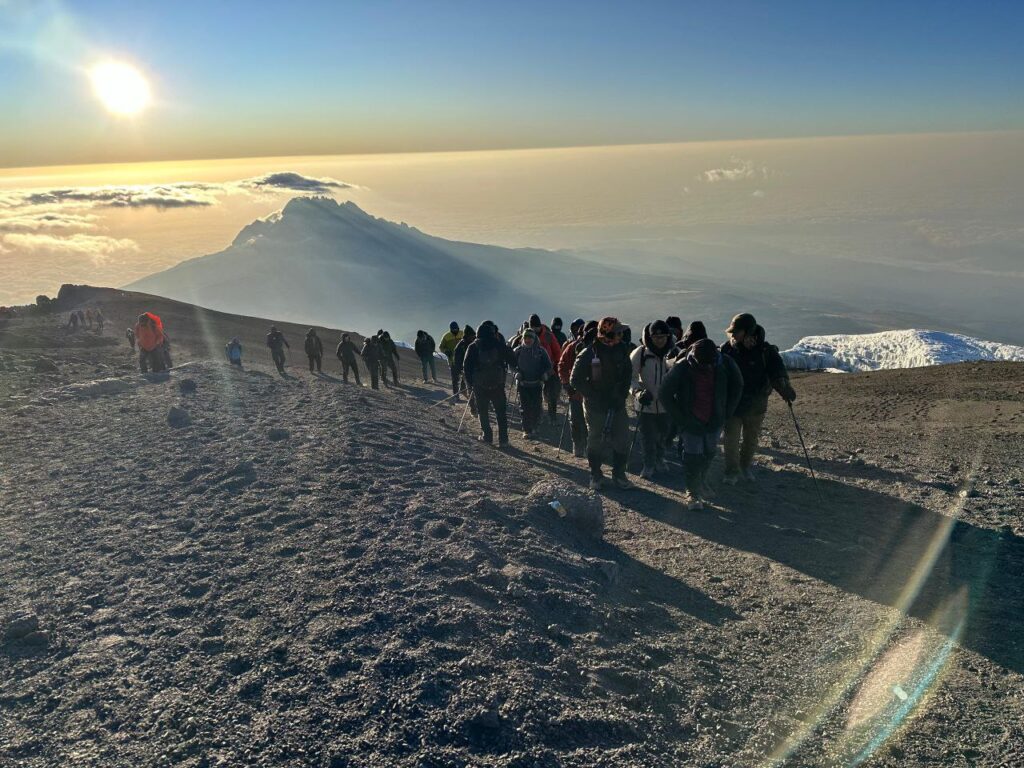
- Day 6: Summit night – depart around midnight, arrive at Uhuru Peak (5,895 m) around sunrise, descend to Mweka Camp (~3,100 m)
- Day 7: Final descent to Mweka Gate and transfer to Moshi
All routes are basically the same shape: a slow climb, at least one acclimatization day, a hard overnight summit push and a quick descent. The details — scenery, camp names, total days — vary from route to route, but the basic pattern doesn’t.
THE BEST TIME TO CLIMB KILIMANJARO
Kilimanjaro can be climbed at any time of year but there are two dry season windows which are the best for conditions:
- June–October (most popular window, coinciding with clearer skies and dry season in East Africa)
- January-early March (a quieter, still-good window before the long rains)
The long rains (March–May) and short rains (November) bring wetter, more challenging conditions and are generally avoided by most operators, though the mountain doesn’t close and some experienced trekkers specifically opt for the quieter shoulder season.
FAQ’s (Frequently Asked Questions)